
Nakanoshima Qross
- TOP
- KANSAI Startup Ecosystem
- Nakanoshima Qross
Nakanoshima Qross (Kita-ku, Osaka)
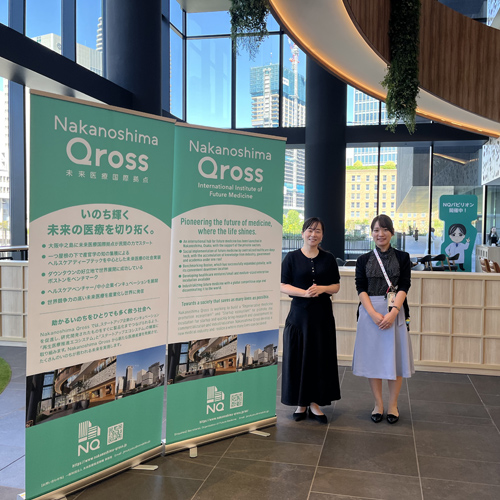
Opened in June 2024, Nakanoshima Qross is managed by the Future Medical Promotion Organization, a general incorporated foundation established through collaboration between private companies and Osaka Prefecture, with Dr. Yoshiki Sawa serving as its chairman. This 16-story facility functions as a hub for advancing the industrialization of next-generation medical care, uniting medical institutions, corporations, startups, and support organizations under one roof. The complex is divided into three main areas: the Future Medical MED Center, the Future Medicine R&D Center, and the Nakanoshima International Forum, each responsible for the practice, innovation, and sharing of future medicine. Additionally, the facility includes an iPS cell manufacturing site operated by the Kyoto University iPS Cell Research Foundation.
Enhancing the Global Presence of Japan-Originated Life Sciences
Nakanoshima Qross is positioned as an industrial base for the life sciences, including drug discovery and healthcare. In addition to medical institutions such as cardiology and ophthalmology clinics, the facility features offices of pharmaceutical and medical device companies. Its rental laboratories and offices also provide spaces for both domestic and international startups. A key focus of Nakanoshima Qross is fostering an ecosystem through active networking, aimed at nurturing startups with the potential to succeed on the global stage.
Equal Partnerships Across Academia, Industry, and Government
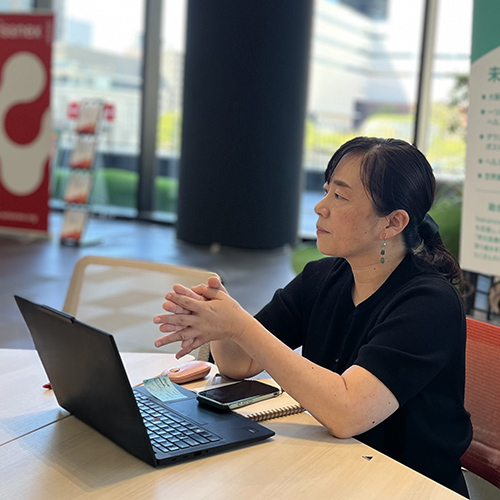
Located on the former site of Osaka University’s Nakanoshima campus, Nakanoshima Qross was developed as a symbolic hub for healthcare through collaboration among major Kansai-based corporations, local governments, and universities. Cutting-edge technology advancements are achieved through partnerships not only with Osaka University but also with other national and private universities across the Kyoto-Osaka-Kobe region. When it comes to commercialization, the involvement of large corporations is indispensable. Misato Yoshida, an expert supporter at the Organization of Future Medicine, explains, “We have made it a principle to become equal partners.” Both academia and industry have respected each other’s expertise and exchanged knowledge from one another, which has been the driving force in building a robust ecosystem.
Visualizing the Community to Accelerate Open Innovation
Since opening in June 2024, the facility has prioritized community-building through pitch events and workshops. The goal is to foster connections and empathy among entrepreneurs, VCs, and other players within each business domain, thereby facilitating open innovation. For example, in the medical device field, relationships are systematically mapped—such as identifying Startup A, Support Organization B, and VC C—enabling the identification and resolution of missing links.
Building Networks with Overseas Ecosystems
Another distinctive feature is the emphasis on building networks with global life science ecosystems, particularly in the United States. Takami Murao, Manager, Startup Support Department, Organization of Future Medicine, explains, “We are focusing on building networks with overseas life science ecosystems.” While North America is the main market for healthcare game changers, Nakanoshima Qross is also working to develop markets in emerging regions such as Southeast Asia, the Middle East, Africa, and Oceania, leveraging solutions tailored to Japan’s aging society. Yoshida adds, “Kansai universities are highly active in partnering with these emerging regions, and we aim to build on that experience to expand our business.”
Innovation Campus to Open in 2026
To further strengthen its global strategy, Nakanoshima Qross is set to launch a new innovation campus in spring 2026, which will feature conference rooms, coworking spaces, and offices. This joint project between Nippon Life Insurance Company and the Cambridge Innovation Center (CIC) in the United States aims to bring together startups, research institutions, local governments, investors, and companies in the life sciences for open exchange and collaboration.
With the opening of the new Naniwasuji Line in 2031, providing direct access from Osaka Station through Nakanoshima to Kansai International Airport, the facility’s international connectivity will be significantly enhanced, further elevating its status as a global innovation hub.
Case Study: PITTAN Inc. – Creating Preventive Healthcare Businesses through Collaboration at Nakanoshima Qross
Launching Businesses That Advance Preventive Medicine Through Internal Care
PITTAN Inc.
As one of the world’s most rapidly aging societies, Japan is facing increasing social security costs. Extending healthy life expectancy and narrowing the gap between healthy and unhealthy years has become an urgent issue, with preventive medicine recognized as a key solution. PITTAN provides a service that visualizes the nutritional status of skin and muscles using trace amounts of sweat. Leveraging the strategic location of its headquarters at Nakanoshima Qross, PITTAN collaborates with various industries and medical institutions to develop businesses that promote preventive healthcare, starting with internal care.
Kazuya Tsujimoto, CEO, PITTAN Inc.
After completing his master’s and doctoral studies in MEMS (Micro-Electro-Mechanical Systems) at Kyoto University, Tsujimoto worked at Tokyo Electron and consulting firms before founding PITTAN in 2022.
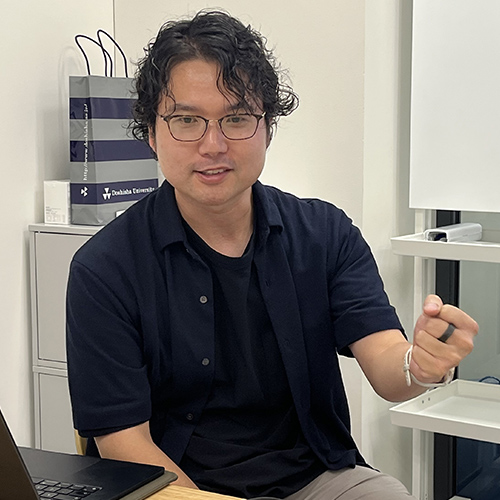
A Compact 18cm-Cube Machine Visualizes Internal Body Status in 10 Minutes
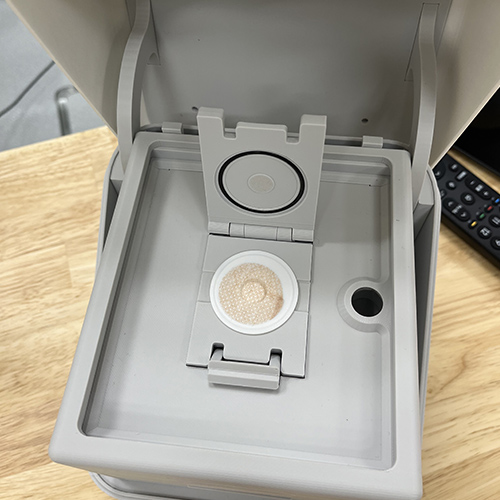 PITTAN has developed “Pitagoras,” a compact, cube-shaped analysis machine measuring just 18 centimeters on each side. The device collects a small amount of sweat via a patch placed on the skin for three minutes. Once the patch is inserted into the Pitagoras analyzer, it visualizes internal body status in only ten minutes—a process previously challenging with conventional testing methods. The device is already in use at locations such as Hankyu Department Store Umeda Main Store and Cosme Kitchen in Yurakucho Lumine.
In skin mode, Pitagoras provides a score-based alert regarding potential skin conditions based on current internal status. In fitness mode, it offers advice such as which muscle areas may develop more easily. The system then recommends foods, supplements, and skincare products, connecting customers to goods and services available at the store. Additionally, PITTAN is also preparing to offer semi-personalized supplements under a white-label model bundled with Pitagoras-equipped shops.
The device features a cassette-type module for various analyses, including hair samples, allowing hair salons to use it to promote hair care products. PITTAN is also collaborating with Osaka University on research aimed at visualizing cellular aging tendencies.
Innovation Happens in the Heart of the City
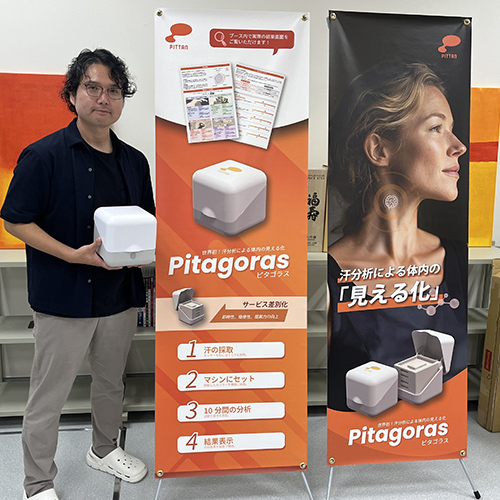 CEO Tsujimoto emphasizes that both location and concept are vital for startups to succeed by engaging large companies and other stakeholders. Particularly in the wellness sector—which aims to extend healthy life expectancy—collaboration with food, daily goods, and device manufacturers is essential, and Tsujimoto believes that true innovation thrives in vibrant urban settings. Nakanoshima Qross provides such an environment, with well-equipped shared labs and containment measures up to P2 level, allowing in-city clinical trials. The abundance of late-night dining options nearby also helps maintain employee motivation.
A key attraction of Nakanoshima Qross is the close collaboration between industry and medicine, which is essential for creating the healthcare industry needed to achieve wellness. Known as a hub for regenerative medicine, the facility supports the advancement of preventive medicine—crucial for wellness—as regenerative therapies become more widespread. PITTAN is actively collaborating with onsite clinics and research labs at food and pharmaceutical companies to drive innovation.
Creating Business at the Intersection of Manufacturing, Healthcare, and Well-being
With a background in semiconductor manufacturing equipment, Tsujimoto has a deep passion for manufacturing. The core fluid control technology in Pitagoras is among the world’s best, and Tsujimoto views Japan’s advanced response to demographic challenges as an opportunity to develop globally pioneering solutions. By integrating manufacturing, healthcare, and well-being, PITTAN aims for exponential growth. “When it comes to the human side of business, including hospitality and close personal connections, Kansai people are better suited than those in Tokyo. For a company like ours, it was only natural to choose Nakanoshima Qross, where key ecosystem players are concentrated,” says Tsujimoto.
PITTAN is now looking to expand into Southeast Asia—including Singapore, Thailand, Vietnam, Indonesia, and Malaysia—with plans to establish a Hong Kong subsidiary in October. The new direct rail line to Kansai International Airport will make the market feel even closer. Nakanoshima Qross actively hosts events inviting overseas VCs specializing in healthcare, and PITTAN is building its network and pursuing new growth strategies.